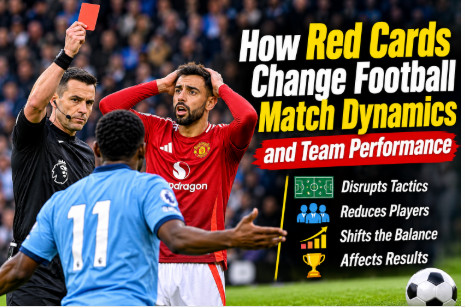
How Red Cards Change Football Betting Odds and Match Predictions
A football match can take an unexpected turn when the referee shows a red card. A team that looked comfortable and confident just moments earlier may suddenly find itself struggling to defend, maintain possession or create scoring opportunities. For football bettors, this is one of the most important moments to understand, particularly when following live matches.
How red cards change football betting odds and match predictions is an important subject for anyone interested in understanding football betting markets. A sending-off can influence match outcomes, goal expectations, both teams to score markets and several other betting options.
However, reacting immediately to a red card without studying the circumstances can lead to poor decisions. Not every team that loses a player automatically loses the match, and not every opponent with a numerical advantage will take full control.
Understanding how to interpret these situations can help bettors make more informed decisions when analysing football fixtures.
1. Understand How a Red Card Changes Match Odds
One of the first things to notice after a red card is how bookmakers adjust their odds.
When a team receives a sending-off, its chances of winning may decrease because it now has fewer players to defend, attack and compete for possession. Consequently, the opposing team's winning odds may become shorter.
For example, imagine a match between two relatively balanced teams. Before kick-off, both sides have competitive winning odds. If one team receives a red card in the first half, bookmakers may immediately adjust the prices to reflect the new situation.
However, the size of the adjustment depends on several factors, including the scoreline, the minute of the dismissal, team strength and the identity of the player sent off.
2. Consider the Timing of the Red Card
The minute a player receives a red card can significantly influence betting predictions.
An early sending-off gives the opposition more time to exploit its numerical advantage. This may increase the possibility of additional goals, particularly when the affected team struggles to maintain its defensive organisation.
A red card in the final ten minutes is a different situation. There may not be enough time for the opposing team to take full advantage, especially when it is already leading comfortably. When analysing a live betting opportunity, consider how much playing time remains.
For example, a team receiving a red card in the 20th minute may face a difficult 70 minutes. However, a dismissal in the 85th minute may have a much smaller influence on the final result.
3. Study the Current Scoreline Before Considering Over and Under Goals
Red cards can influence the total number of goals scored in a match, but the relationship is not always straightforward.
When a defensive team receives a red card, its opponent may create more opportunities and increase its attacking pressure. This can make the over-goals market more interesting to analyse.
However, the scoreline matters. If the team with ten players is already leading, its manager may instruct the remaining players to defend deeper and protect the advantage. This could reduce the tempo and limit the number of clear scoring opportunities.
Similarly, when a strong attacking team receives a red card while trailing, its ability to recover may become more difficult.
Before considering over 1.5, over 2.5 or under-goals markets, examine the current score, attacking statistics and how both managers have responded to the dismissal.
4. Evaluate Both Teams to Score Opportunities
The both teams to score market is another option that may be influenced by a red card.
A team playing with ten men may struggle to defend its penalty area, giving the opposition additional opportunities to score. At the same time, the team with a numerical disadvantage may still possess enough attacking quality to threaten through counterattacks.
However, bettors should not automatically assume that both teams will score. If the affected team withdraws its attacking players to strengthen the defence, its ability to create scoring opportunities may decrease considerably.
On the other hand, an attacking side with a strong forward line may continue threatening even when reduced to ten players. Examine recent attacking performances, shots on target, dangerous attacks and substitutions before considering the both teams to score market.
5. Pay Attention to the Player Who Receives the Red Card
Not all sending-offs have the same tactical consequences. A red card shown to a central defender may create serious problems for a team's defensive organisation. Losing a player responsible for marking opposition forwards and protecting the penalty area can leave significant gaps.
When a defensive midfielder is dismissed, the team may lose an important shield in front of its backline. However, losing a striker may have a different effect. Although the team loses an attacking option, its defensive structure might remain relatively stable.
6. Watch How the Manager Responds to the Sending-Off
A manager's reaction can provide useful information for live football betting analysis. Some coaches immediately introduce another defender to protect their backline. Others sacrifice an attacking midfielder or forward to maintain balance in the remaining positions.
These substitutions can influence the direction of the match. For example, replacing a striker with a defensive midfielder may reduce the affected team's attacking threat. It could also encourage the opposition to commit more players forward.
Bettors should therefore pay attention to substitutions; formation changes and the positions players occupy after the dismissal. A team that reorganises effectively may defend much better than expected.
7. Avoid Common Live Betting Mistakes After a Red Card
One of the biggest mistakes bettors make is reacting emotionally whenever a player receives a red card. The incident can create excitement, and many people immediately assume that the team with eleven players will dominate the remainder of the match.
Unfortunately, football does not always follow that pattern.
Here are some mistakes worth avoiding:
- Chasing shorter odds: A sudden price reduction does not automatically create a valuable betting opportunity.
- Ignoring the scoreline: A team protecting a lead may approach the remainder of the match differently from one chasing a goal.
- Overlooking team quality: Some teams have enough defensive organisation and experience to survive with ten players.
- Ignoring match statistics: Possession, shots on target and attacking pressure can reveal whether the numerical advantage is producing meaningful opportunities.
- Betting without sufficient information: Avoid rushing into a market before understanding the tactical changes.
The best approach is to remain patient and assess the situation rather than allowing one incident to dictate every decision.
8. Use Red Card Information Alongside Other Match Statistics
Red cards should never be the only factor in a football betting prediction. For better analysis, combine the incident with other useful information, including recent team form, head-to-head performances, possession statistics, expected goals (xG), shots on target and defensive records.
For instance, a team may receive a red card but still have a strong defensive record and an experienced goalkeeper. These factors could help it resist pressure. Similarly, an opponent with an extra player may have poor attacking efficiency and struggle to convert its chances. Understanding these details provides a more balanced assessment of the match.
Conclusion
Red cards can significantly influence football betting odds, live predictions and several betting markets. However, their impact depends on more than the number of players remaining on the pitch.
The timing of the dismissal, current scoreline, position of the affected player, team quality and managerial response all contribute to what happens next.
For bettors, the most sensible approach is to study these factors before considering any live betting opportunity. Avoid emotional decisions, understand how bookmakers adjust their odds and remember that a numerical advantage does not guarantee a particular result.
Ultimately, successful football betting analysis requires patience, research and an understanding of how different match situations influence team performance. Red cards provide an important lesson in why football predictions should always consider the full picture rather than relying on one incident.



💬 Comments (0)
No comments yet. Be the first!
Leave a Comment