
Why Shots Inside the Penalty Area Matter More Than Total Shots in Football
When analysing a football match, one of the first statistics many people check is the total number of shots taken by each team. It seems logical to assume that the side attempting more shots is more dangerous and has a better chance of scoring. However, football does not always work that way. A team can register 18 attempts without seriously troubling the goalkeeper, while another may create just six opportunities and score twice.
The difference often comes down to where those attempts are taken.
Shots inside the penalty area usually provide a clearer picture of a team's attacking threat because they indicate how often players manage to reach dangerous positions close to goal. Although attempts from outside the box can produce spectacular goals, the location of a shot often matters more than the overall number.
Understanding this difference can help football followers look beyond basic statistics and recognise which teams are genuinely creating promising scoring opportunities.
1. Not All Shots Carry the Same Threat
A shot is recorded whenever a player attempts to score, but that does not mean every attempt has an equal chance of finding the net.
Consider a team that takes 16 shots during a match. Ten come from outside the penalty area, three are blocked by defenders, and only three are taken from close-range positions. Despite its impressive total, the team may have struggled to create clear opportunities.
Now imagine another side recording just eight shots, with six coming from inside the box. Its lower shooting figure might hide a much more dangerous attacking performance.
This is why shot location is an important part of football analysis. Attempts from closer positions generally give players a better opportunity to direct the ball accurately, beat the goalkeeper and take advantage of defensive mistakes. Rather than judging an attack by volume alone, it makes sense to examine the quality of the chances created.
2. Close-Range Opportunities Often Produce Better Scoring Chances
The distance between a player and the goal can significantly influence the difficulty of scoring. When attackers receive the ball inside the penalty area, they are often closer to the target and have a better opportunity to test the goalkeeper.
This does not automatically make every attempt dangerous. A striker surrounded by three defenders may have very little room to shoot, even from a good position. However, a player receiving an accurate pass near the six-yard box will usually have a more promising opportunity than someone attempting a powerful shot from 30 yards.
Shots inside the box can also come from different attacking situations, including crosses, cutbacks, through balls, rebounds and defensive errors.
These situations often force defenders to make quick decisions under pressure. When a team repeatedly creates such opportunities, it may indicate that its attacking movements are causing serious problems for the opposition.
3. Total Shots Can Create a Misleading Impression
One of the biggest mistakes in football statistics is treating a high shot count as proof of attacking superiority. Some teams shoot frequently because they struggle to break down organised defences. Instead of finding a passing route into the penalty area, their players resort to speculative efforts from long distances.
These attempts increase the total without necessarily increasing the likelihood of scoring.
For example, a midfielder may repeatedly shoot from outside the box because the opposition is defending deep. Although these efforts count towards the team's shooting statistics, many may be comfortably saved or miss the target.
This explains why a team can dominate the shot count but still lose the match. Looking at shots inside the penalty area helps reveal whether a side is genuinely penetrating the opposition's defensive structure or simply attempting to score from difficult positions.
4. Penalty Area Shots Reveal the Effectiveness of Attacking Play
A team's ability to create opportunities inside the box can reveal a lot about its attacking organisation.
Successful attacks often involve coordinated movement between midfielders, wingers and forwards. A winger may attract a defender before delivering a low cross, while a midfielder makes a late run into the penalty area. A striker may also drop deeper to create space for another attacker.
When these movements work, the team can generate shooting opportunities from promising positions.
This is particularly useful when comparing teams with different playing styles. A possession-based side might complete numerous passes but struggle to enter the box, while a direct team may create fewer attacks but reach dangerous positions more regularly.
The number of attempts from inside the penalty area provides an additional way to assess how effectively each side turns its attacking approach into genuine scoring opportunities.
5. Shot Quality Helps Explain Expected Goals (xG)
Another important statistic connected to shot location is Expected Goals (xG).
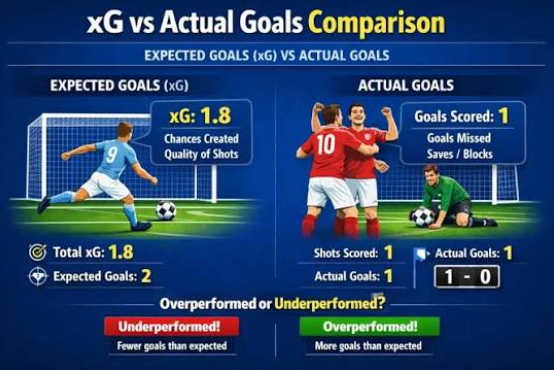
Expected Goals estimates the likelihood of a particular shot resulting in a goal based on factors such as shooting distance, angle, body part and the type of opportunity created. Different statistical models may consider additional details.
Generally, a close-range attempt from a central position carries a higher xG value than a speculative effort from outside the box.
For instance, a team might register 12 shots but produce an xG of only 0.65 because most attempts came from difficult positions. Another team could record seven shots and generate an xG of 1.80 after creating several clear opportunities.
This difference shows why shot location and chance quality deserve attention. However, xG should not be treated as a guarantee of goals. It is a way of measuring the quality of chances, not predicting exactly what will happen in an individual match.
6. Defensive Strength Can Also Be Measured Through Box Shots
This statistic is not only useful when studying attacking teams. It can also reveal how effectively a defence protects its goal.
A team may allow plenty of shots but still defend reasonably well if most attempts come from outside the penalty area. Its defenders could be doing an excellent job of closing passing lanes, protecting central spaces and forcing opponents into uncomfortable shooting positions.
On the other hand, a side that regularly allows opponents to shoot from inside the box may have serious defensive problems. Poor marking, slow reactions, ineffective tackling and gaps between defenders can all contribute to this situation.
When analysing defensive performances, checking how many shots conceded inside the penalty area can therefore provide valuable information that the total number of shots against a team might not reveal.
7. Why This Statistic Matters When Comparing Football Teams
Comparing shots inside the box can help football followers understand the difference between teams that look busy in attack and those that consistently create dangerous situations.
Suppose two clubs are preparing for an important fixture. Both have averaged 13 shots per match over their last five games. At first glance, their attacking numbers appear similar.
However, a closer look reveals that one averages eight shots inside the penalty area, while the other manages only four. That difference deserves attention. The first team may be doing a better job of getting behind defensive lines and creating opportunities close to goal. The second might rely heavily on long-range attempts.
Before drawing conclusions, it is also important to consider the strength of recent opponents, home and away performances, injuries and the number of matches played. No single statistic tells the complete story, but combining shot locations with other performance indicators makes football analysis more meaningful.
Why Total Shots Should Still Be Considered
Although shots inside the penalty area are particularly useful, total shots should not be ignored. Long-range attempts can produce goals, force difficult saves and create rebounds. They can also push defenders out of position, opening spaces for teammates to exploit.
Furthermore, some teams deliberately use long-range shooting as part of their attacking strategy. The better approach is to consider both statistics together. Look at total attempts, shots inside the box, shots on target and expected goals. This provides a broader understanding of how a team attacks and whether its efforts are producing worthwhile opportunities.
Conclusion
Football is not simply about how often a team shoots but how effectively it creates opportunities to score. A high shot count can look impressive, yet it may hide an attack that struggles to penetrate the opposition's defence.
Shots inside the penalty area offer a more meaningful indication of how frequently a team reaches dangerous positions and creates opportunities close to goal.
For anyone studying football performances, paying attention to shot locations can reveal details that ordinary match statistics often overlook. The next time you compare two teams, look beyond the total shots. Sometimes, the most imp






💬 Comments (0)
No comments yet. Be the first!
Leave a Comment