
Why Teams with Fewer Shots Sometimes Win More Football Matches
Football is a game where statistics can tell interesting stories, but they do not always reveal the complete picture. One of the most common assumptions among supporters is that a team recording more shots during a match must have performed better and deserves to win. However, football regularly produces results that challenge this belief.
A side can spend most of the afternoon attacking, enjoy greater possession and register twice as many attempts as its opponent, yet still walk away without a point. Meanwhile, a team with fewer shots can take its opportunities, defend intelligently and secure a comfortable victory.
This explains why teams with fewer shots sometimes win more football matches. Success is not simply about how frequently a team attempts to score. It is also about the quality of those opportunities; the decisions players make and how effectively a team manages different stages of a match.
Why Football Teams With Fewer Shots Can Still Win Matches
Quality of Chances Matters More Than Shot Quantity
Not every shot represents a genuine scoring opportunity. A team can record 18 attempts without seriously troubling the goalkeeper if most of those efforts come from difficult angles, long distances or crowded areas.
Another team might register just seven shots but create three excellent opportunities inside the penalty area. If two of those attempts find the net, it becomes clear why the side with fewer shots can win.
This is where shot quality becomes important. A well-positioned striker receiving a low cross close to goal generally has a better chance of scoring than a midfielder attempting a powerful effort from 30 yards.
The number of attempts provides useful information, but understanding where those attempts come from makes the statistics more meaningful.
Clinical Finishing Makes a Huge Difference
Some teams do not need several opportunities to score. They have attackers who understand when to shoot, how to position themselves and how to remain composed under pressure.
Clinical finishing can completely change the outcome of a match. When a striker converts an early opportunity, the team may not need to create another ten chances to secure victory.
Consider a situation where Team A records 16 shots but scores once, while Team B manages six attempts and finds the net twice. Team A may have enjoyed more attacking moments, but Team B has been more effective in front of goal.
This is why goal conversion rate is an important statistic when studying football performances. It helps explain how efficiently a team turns its attempts into goals. However, finishing should also be assessed over several matches because a team can experience unusually good or poor conversion rates in a single game.
Strong Defensive Organisation Reduces Opponents' Chances
A team does not necessarily need to dominate possession or attack constantly to control a football match. Some managers prefer a disciplined defensive structure that limits the opposition's opportunities in dangerous areas.
By keeping their defensive lines compact, closing passing lanes and protecting the space around the penalty box, these teams make it difficult for opponents to create clear chances. The opposition may still record plenty of shots, but many will come from uncomfortable positions.
Meanwhile, the defensively organised side waits for opportunities to break forward. One successful counterattack, a well-delivered corner or a mistake from an opposing defender could be enough to decide the contest.
This approach demonstrates that defensive organisation can be just as important as attacking activity when determining football results.
Counterattacking Football Creates Dangerous Opportunities
Some teams deliberately allow their opponents to have more possession because they are comfortable playing without the ball.
Instead of committing too many players forward, they remain organised and look for opportunities to attack quickly when possession changes hands.
Counterattacking football can be particularly effective against teams that push their defenders high up the pitch. Once the ball is recovered, a quick pass into open space can expose the opposition's defensive weaknesses.
In these situations, a team might produce only a handful of attacking moves but make each one extremely dangerous.
The difference is often speed, movement and decision-making. Rather than spending several minutes building an attack, counterattacking teams aim to reach the opposition's penalty area before defenders can recover their positions. This explains why fewer shots do not automatically mean weaker attacking performance.
Possession Does Not Always Mean Control
Another reason teams with fewer shots can win is that possession statistics are sometimes misunderstood.
Having the ball for 65 per cent of a match does not guarantee that a team is controlling the important moments. A side can pass repeatedly across the midfield without creating meaningful openings.
Some teams enjoy possession in harmless areas because their opponents are happy to defend deep and protect the spaces that matter most. In contrast, the team with less possession might be more direct, purposeful and dangerous whenever it wins the ball.
Effective football is not always about having the ball for longer. It is about using possession intelligently, recognising opportunities and making the right decisions in attacking areas.
Therefore, football possession statistics should be considered alongside shots on target, chance creation and other performance indicators.
Tactical Discipline Helps Teams Protect Their Advantages
Scoring the first goal can change the entire direction of a football match. A team that takes an early lead may decide to become more cautious, reduce unnecessary attacking risks and concentrate on protecting its advantage.
This can result in fewer shots for the winning side, particularly when the opposition begins committing more players forward.
Rather than chasing additional goals, the leading team focuses on maintaining its defensive shape, winning important challenges and controlling the tempo.
This does not necessarily mean the team has stopped trying to attack. It simply means the manager has adjusted the approach to suit the situation.
Tactical discipline allows teams to manage matches according to the scoreline instead of following one attacking plan for the entire 90 minutes.
Expected Goals Provide a Better Understanding of Shooting Statistics
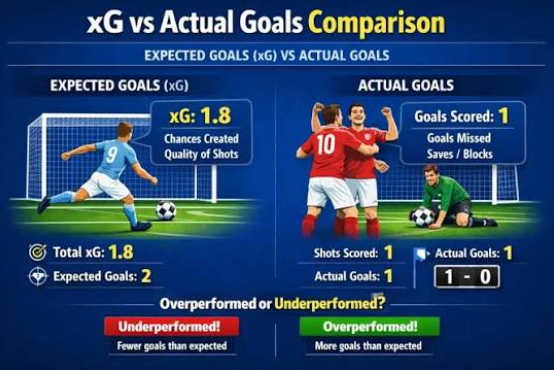
Anyone analysing football performances should understand the importance of expected goals, commonly known as xG.
Expected goals measure the quality of scoring opportunities by estimating how likely a particular shot is to result in a goal. Factors such as shooting distance, angle and the type of attacking situation can influence the value.
For example, a team recording 15 shots might finish with an xG of 0.9 because most attempts were difficult. Another side could register only six shots but produce an xG of 2.1 because it created several excellent opportunities.
This helps explain why shot totals alone can be misleading. However, xG is not a perfect measurement of performance. Different statistical providers may use different models, and the figures do not account for every detail of a player's execution.
Combining expected goals, shots on target and match footage provides a more balanced understanding of how teams perform.
How to Use Shot Statistics When Analysing Football Matches
When examining upcoming fixtures or reviewing previous results, it is important not to judge teams purely by their total number of shots.
Consider these factors together:
- Shots on target: Determine how many attempts actually test the goalkeeper.
- Expected goals: Examine the quality of opportunities created.
- Goal conversion rate: Assess how efficiently the team finishes its chances.
- Defensive record: Check whether the team regularly limits dangerous opportunities.
- Counterattacking ability: Consider how effectively it attacks when opponents lose possession.
- Recent performances: Look beyond one match to identify consistent patterns.
These details can provide a clearer picture of a team's strengths and weaknesses than simply comparing the number of attempts.
Conclusion
Football is not a competition to see which team can produce the highest number of shots. It is about scoring goals, preventing opponents from scoring and making better decisions during important moments.
Teams with fewer shots sometimes win more football matches because they create better opportunities, finish more efficiently and understand how to manage different situations. Their opponents might enjoy greater possession and produce more attempts, but those advantages mean very little without effective execution.
For anyone interested in football statistics and match analysis, the biggest lesson is simple: look beyond the numbers. A team that shoots less might still be the more dangerous, organised and effective side on the pitch.




💬 Comments (0)
No comments yet. Be the first!
Leave a Comment