How to Analyse Football Matches When Two Teams Have Similar Statistics
Analysing a football match becomes particularly challenging when both teams appear equally matched on paper. They may have similar winning records, comparable goal-scoring numbers, almost identical defensive statistics and players with similar individual performances. At first glance, choosing which side has the advantage can feel like guessing.
However, football matches are rarely decided by statistics alone. Two teams can produce almost identical numbers while having completely different strengths, weaknesses and approaches to the game. One might be more effective against attacking opponents, while the other performs better when controlling possession. These differences can become important when they meet.
This is why football match analysis requires more than comparing league positions or recent results. When the numbers look similar, the real task is to identify the smaller details that could influence the outcome.
Here are some important factors to examine when analysing closely matched football teams.
1. Look Beyond Recent Results
One of the first things to consider is each team's recent form. However, simply counting wins, draws and defeats does not always reveal the full picture.
For example, two teams might have won three of their last five matches. Yet, their performances could be very different. One team may have defeated strong opponents, while the other collected victories against clubs struggling near the bottom of the table.
The quality of opposition matters because not every result carries the same significance.
Consider the following:
- Did the team perform well against stronger opponents?
- Were recent victories convincing or narrowly achieved?
- Did the team struggle against opponents with similar playing styles?
- Were recent defeats caused by poor performances or individual mistakes?
Examining these details helps establish whether a team's recent form reflects genuine improvement or a favourable run of fixtures.
2. Compare Home and Away Performances
Overall statistics can sometimes hide important differences between two teams. A club might have an impressive record across the season but struggle whenever it plays away from home.
This makes home and away football statistics particularly useful when analysing balanced fixtures.
Look at how both teams perform in their respective environments. Consider their average goals scored, goals conceded, number of victories and ability to maintain defensive organisation.
A team that consistently creates chances at home could have an advantage over an opponent that struggles on the road, even when their overall records are similar.
Also consider whether either side has recently improved or declined in a particular environment. Such patterns can provide useful information that general statistics might overlook.
3. Examine Their Playing Styles and Tactical Approaches
Two teams can have similar statistics but completely different football identities. One side might prefer possession-based football, patiently moving the ball through midfield. The other could rely on quick transitions, direct passes and counterattacks.
When these approaches meet, the tactical battle becomes important.
For example, a possession-oriented team may struggle against an opponent that presses aggressively and closes down passing options. Similarly, a team that relies heavily on counterattacks could find fewer opportunities against a disciplined defence that refuses to push too many players forward.
Pay attention to:
- Possession percentage and passing accuracy.
- High pressing and defensive positioning.
- Counterattacking ability.
- Width and movement in the attacking third.
- How effectively each team handles pressure.
Understanding these football playing styles can help explain why one team may have a tactical advantage despite having similar overall numbers.
4. Study Expected Goals Rather Than Goals Alone
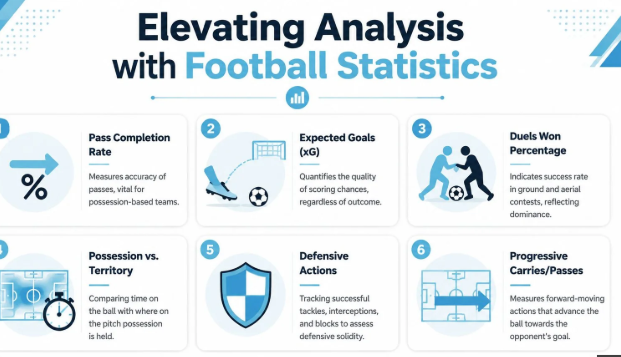
Goals scored and conceded are important indicators, but they do not always explain how well a team has performed. This is where Expected Goals (xG) becomes useful.
Expected goals measure the quality of scoring opportunities created and conceded. A team that scores frequently but produces relatively low-quality chances might be benefiting from an unusually high conversion rate.
Meanwhile, another team may have scored fewer goals despite creating several excellent opportunities.
When comparing two closely matched teams, examine:
- Expected goals for each match.
- Expected goals conceded.
- The difference between actual goals and expected goals.
- Whether the team regularly creates clear scoring opportunities.
- Whether its defensive performances are genuinely strong.
For example, if Team A has scored 12 goals from an expected goals figure of 8, while Team B has scored 10 from an expected goals figure of 11, the second team may have been creating better opportunities despite scoring fewer goals.
These figures do not guarantee what will happen next, but they provide a deeper understanding of attacking and defensive performance.
5. Investigate Injuries, Suspensions and Squad Depth
Team statistics often represent performances recorded with different players available. Before making a comparison, check whether both sides are likely to field their strongest line-ups. The absence of one important player can change how a team operates.
A defensive midfielder who protects the back four, for instance, may be more influential than his individual statistics suggest. Similarly, losing a creative midfielder could reduce a team's ability to create opportunities.
Consider the following:
- Are important players injured or suspended?
- Is the first-choice goalkeeper available?
- Does the team have suitable replacements?
- Are key attackers returning from injury?
- Has the squad been affected by fixture congestion?
Team news and player availability can provide valuable context, particularly when the statistical differences between two opponents are very small.
6. Examine Head-to-Head Records Carefully
Previous meetings can offer useful information, especially when two teams have a history of producing competitive encounters. However, head-to-head statistics should not be treated as a reliable prediction on their own.
A team might have dominated the previous meetings because it had a stronger squad or a different manager at the time. Those circumstances may no longer exist. Instead of concentrating only on the number of previous victories, examine how the matches were played.
Did one team consistently create more chances? Was there a particular tactical weakness that kept appearing? Did the home side enjoy a significant advantage? Recent meetings between teams with similar playing styles can sometimes reveal patterns worth considering.
7. Pay Attention to Motivation and Match Importance
Football statistics rarely capture everything happening around a team. The importance of a particular fixture can influence how players approach the game. A club fighting for survival may approach a match differently from one with little left to achieve in the competition.
Likewise, teams involved in title races or qualification battles may be under considerable pressure to collect points. Consider the competition, league position, upcoming fixtures and possible rotation decisions.
Motivation should not be used as an excuse to predict results without evidence. However, understanding the circumstances surrounding a match can help explain why two statistically similar teams might perform differently.
8. Study Defensive Weaknesses and Set-Piece Performance
When two teams have comparable attacking numbers, defensive organisation could become the deciding factor. Look beyond the number of goals conceded and examine how those goals happen.
Does one team regularly struggle against crosses? Does it concede opportunities through defensive mistakes? Is it vulnerable when opponents attack quickly after winning possession?
Set pieces also deserve attention. Corners, free kicks and penalties can become particularly important in tightly contested matches where open-play opportunities are limited.
A team with strong aerial players and well-organised set-piece routines may have an advantage over an opponent that struggles to defend deliveries into the penalty area.
These smaller details can help distinguish two sides whose general statistics appear almost identical.
9. Consider the Match Tempo and Possible Game Scenario
Another useful approach is to think about how the match could develop. Some teams perform better when the game is open and chances are created at both ends. Others prefer slower matches where they can maintain their defensive shape and control possession.
Ask yourself what could happen if either team scores first. Will the opponent become more attacking and leave spaces behind? Can the leading team defend its advantage? Does either side have enough attacking quality to recover after conceding?
This type of football match analysis helps move beyond basic statistics and consider how the teams might respond to different situations.
10. Avoid Forcing a Prediction When the Evidence Is Inconclusive
Perhaps the most important lesson when analysing closely matched teams is knowing when the available information does not provide a clear advantage.
Not every football fixture has an obvious winner. Sometimes, both teams are genuinely balanced, and the most reasonable conclusion is that the match carries considerable uncertainty.
Avoid allowing one impressive statistic or an attractive recent result to influence the entire assessment. Instead, combine tactical information, performance indicators, team news, home and away records and match circumstances before reaching a conclusion.
If the evidence remains evenly balanced, it is better to acknowledge the uncertainty than force a prediction simply because a match is available.
Wrapping Up
Analysing football matches when two teams have similar statistics requires patience and attention to detail. Basic numbers can establish how closely matched the opponents are, but they rarely explain everything that could happen during the game.
The real difference often comes from tactical compatibility, the quality of scoring opportunities, player availability, defensive weaknesses and the circumstances surrounding the fixture.
By combining these factors, football analysts can develop a more complete understanding of closely contested matches. The objective is not to find a hidden winner in every fixture but to make better-informed assessments based on evidence rather than assumptions.









💬 Comments (0)
No comments yet. Be the first!
Leave a Comment