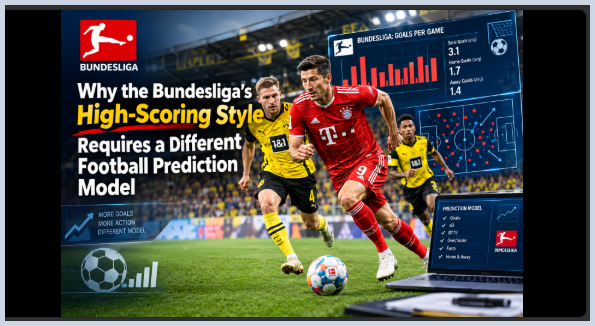
Why the Bundesliga’s High-Scoring Style Requires a Different Football Prediction Model
The Bundesliga stands apart from Europe’s other major leagues because of its relentless tempo. While the Premier League is often associated with competitive balance and Serie A with tactical structure, German football is defined by vertical attacking play, aggressive pressing and a willingness to leave space in behind.
That identity makes it one of the most exciting leagues to watch and one of the most challenging for anyone building a football prediction model. The 2026/27 season has underlined the point, with 172 goals scored across the opening five matchdays, an average of 3.82 goals per game and a new record for the competition’s opening rounds.
More Goals, More Uncertainty
A high-scoring league provides more data points, but it also introduces greater unpredictability. More goals mean more chances; more momentum shifts and more possible scorelines.
Pressing-heavy teams often create high-quality opportunities in bursts. Expected goals (xG) models can capture that chance quality better than final scores alone, because they measure the likelihood of each attempt rather than simply whether it found the net.
However, the same aggressive approach that produces chances can also expose teams to rapid transitions. A side may control possession and territory, yet still be caught on the counter-attack if its defensive line is pushed too high.
That is why Bundesliga fixtures often carry a wider range of realistic outcomes than matches in more cautious leagues. A 3-2 or 4-1 result is not unusual, so a model should spread probability across several scorelines rather than committing too heavily to one exact outcome.
What a Bundesliga Model Should Prioritise
For a league built around speed and attacking intent, certain metrics matter more than others.
- Expected goals for and against: These reveal whether a team is consistently creating or conceding high-quality chances, rather than simply benefiting from an unusual result.
- Pressing intensity and transition risk: High pressing can generate chances, but it can also make a lead less secure if opponents break quickly.
- Chance quality over volume: A team taking 20 low-value shots may be less dangerous than one creating three clear-cut opportunities.
- Home advantage: Crowd influence remains relevant across the Bundesliga, particularly in intense atmospheres where visiting teams are forced onto the back foot.
- Simulation rather than single predictions: Running a fixture through thousands of simulated outcomes produces a probability distribution, which is more honest than predicting one exact score.
Why Scorelines Can Mislead
In a league where goals arrive quickly, the scoreboard can distort the true balance of play. A team may trail 2-0 despite creating the better chances, then score twice in a short spell and change the entire complexion of the match.
This is why Bundesliga odds should be read as probabilities, not certainties. The key question is not simply which team is more likely to win, but which side is more likely to win the chance battle, creating higher-quality opportunities while limiting dangerous transitions at the other end.
The practical lesson is to respect variance. In a competition where open, end-to-end games are common, overly confident single-scoreline predictions are often misleading. A model should identify the most likely outcome, but also acknowledge the realistic possibility of a shootout.
A Modeller’s Playground
The Bundesliga offers an ideal environment for football modelling: abundant goals, detailed performance data and constant tactical swings. But that same volatility demands discipline.
Lean on expected goals, assess pressing and transition risk, factor in home advantage, and treat every prediction as a probability rather than a guarantee. In a league this fast, understanding uncertainty is not a weakness, it is the difference between interpreting the football properly and being surprised by it.





💬 Comments (0)
No comments yet. Be the first!
Leave a Comment