Premier League stars prepare for careers beyond the pitch
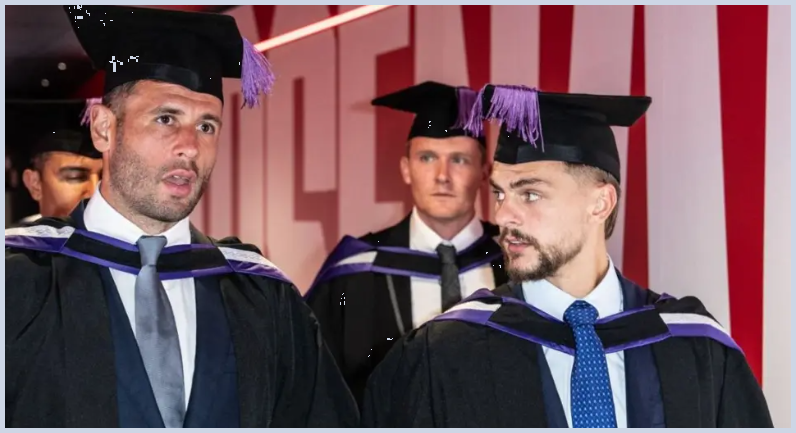
The 2026 graduation ceremony of the PFA Business School looked more like a traditional university event than a gathering of current and former professional footballers.
Held at Arsenal’s Emirates Stadium, the ceremony celebrated players who have balanced demanding football careers with academic work. The graduates included Everton midfielder Kiernan Dewsbury-Hall, Coventry City striker Taiwo Awoniyi, former Chelsea captain César Azpilicueta and several other figures with experience at the highest level.
The programme is designed to prepare participants for careers in football management, club operations and sporting directorship. It allows players to develop skills that could help them become coaches, executives or sporting directors after retirement.
Dewsbury-Hall plans for life after football
Dewsbury-Hall travelled from Merseyside to London for the ceremony after completing a postgraduate diploma in Global Football Sport Directorship.
The 28-year-old, who previously played for Leicester City and Chelsea, is currently enjoying one of the strongest periods of his career. However, he believes professional footballers should begin planning for life beyond the game before their playing days come to an end.
“I hope I still have many years left as a player, but I always want to learn and improve away from football,” Dewsbury-Hall told BBC Sport. “I do not want to finish playing and suddenly have nothing to do.”
He said the course appealed to him because it offered knowledge that could become useful if he eventually receives an opportunity in club leadership or administration.
“It is better to study now rather than wait until your playing career finishes,” he added. “If an opportunity comes up in the future, I will have something useful to support me.”
Dewsbury-Hall also believes the course challenges the common stereotype that footballers are uninterested in education.
“There are intelligent people in every industry, and football is no different,” he said. “Some players may not be interested in studying, but that does not mean they could not do it.”
Awoniyi adds another qualification
Awoniyi has made education a consistent part of his football journey. The Nigeria international already holds a degree in business management and another diploma, meaning the PFA qualification is his third academic achievement. He completed the postgraduate diploma with merit.
The Coventry City striker, who was born in Ilorin, Nigeria, said his commitment to education was influenced by his father, Solomon. His family placed strong emphasis on schooling, and Awoniyi promised to continue studying even after pursuing a professional football career.
“I describe myself as a quiet dreamer,” he said. “I always believed education was important. I promised my father that if I played football, I would continue learning, and I have kept that promise.”
Awoniyi’s career has taken him from the Imperial Soccer Academy to Liverpool and then to German football, where he made a name for himself with Union Berlin. He has since played in the Premier League and remains an important member of the Nigeria squad.
Lessons from a difficult career
Awoniyi’s decision to prepare for life outside football has been shaped partly by the challenges he has experienced as a player.
In May 2025, he suffered a serious abdominal injury after colliding with a goalpost during Nottingham Forest’s match against Leicester City. The injury was severe enough for him to be placed in a medically induced coma.
That experience reinforced his belief that a football career can change suddenly and that players should develop interests and skills beyond the sport.
“Football is not a normal nine-to-five job,” Awoniyi explained. “We may finish training early, and although studying is demanding, there is often time in the evening to do it.”
He added that players should remember they are more than athletes.
“Football is our passion, but we are human beings as well,” he said. “There are many things in life that are bigger than football.”
Azpilicueta shares Champions League story
Azpilicueta, who retired from playing at the end of the previous season, was among the prominent figures at the ceremony. The former Spain international has long believed that education can improve a player both professionally and personally.
He began studying before turning professional with Osasuna at 17. After putting his degree on hold to focus on football, he later returned to education and completed an MBA at Harvard University during his nine-year spell with Chelsea.
Azpilicueta recalled studying on the morning of Chelsea’s 2021 Champions League final against Manchester City. Rather than taking a nap before the evening match, he used the time to concentrate on his academic work.
“Normally, I would rest before a late kick-off, but that day it was impossible because you could hear the supporters and feel the importance of the occasion,” he said.
“Studying helped me focus and improve myself away from football.”
Azpilicueta captained Chelsea to a 1-0 victory over Manchester City in Porto that night. He believes education is not only about preparing for retirement but also about developing leadership qualities during a playing career.
“It is not just preparation for life after football,” he said. “It can help you become a better version of yourself while you are still playing.”
A flexible programme for professionals
The PFA Business School structures its courses around the schedules of professional footballers. Seminars are arranged to limit clashes with training and matches, while students can complete much of their work independently.
Dewsbury-Hall said he sometimes studied on his iPad during journeys back from away fixtures and received confused looks from teammates and other passengers.
For Wycombe Wanderers defender Steve Cook, the programme represented a return to formal education after leaving school. The former Bournemouth captain has already completed coaching qualifications and recognises that the latter part of his playing career is approaching.
The course also exposes students to different areas of the football industry. Speakers include senior figures such as Brighton chief executive Paul Barber, who helps participants understand club governance, strategy and executive decision-making.
Future leaders in football
Not every graduate will immediately pursue a career in football administration. Some may remain in coaching, while others could move into recruitment, club ownership, executive leadership or football operations.
However, the knowledge gained can benefit players regardless of when they decide to use it. The programme covers areas such as sporting strategy, finance, governance, data analysis and leadership, all of which are increasingly important in modern football.
Among the 2026 graduates could be future sporting directors who shape transfer policy, coaches who lead major clubs or executives who oversee international football organisations.
For now, many of the graduates remain focused on their playing careers. But by investing in education early, Awoniyi, Dewsbury-Hall, Azpilicueta and their classmates have already taken important steps towards building successful lives beyond the pitch.








💬 Comments (0)
No comments yet. Be the first!
Leave a Comment