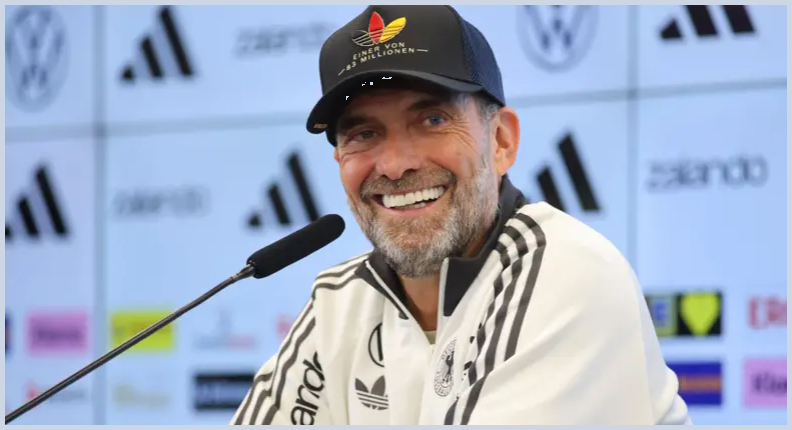
Klopp's Germany Revolution: Reclaiming Pride and Rebuilding the Squad
Since his appointment as Germany head coach in July 2026, Jurgen Klopp has wasted no time reshaping both the narrative and the roster of the German national team. From his first press conference, where he asked media to treat him and his family fairly, to his recent call for "positive patriotism" amid political turbulence, Klopp has positioned himself as more than just a tactician.
"I would very much like to reclaim the flag for myself, for all of us," Klopp said. "I want it so that when someone waves it, no-one thinks: 'What is wrong with you?' Instead, I want people to understand: You are happy and realise how lucky you were to be born, grow up, or move to this wonderful country."
His comments came after the far-right Alternative for Germany (AfD) party's electoral wins in Saxony-Anhalt and Mecklenburg-Western Pomerania. Klopp's message resonated widely, especially given the national team's diversity, many players hail from migrant backgrounds.
Beyond Politics: The Real Mission
While Klopp's off-field messaging has dominated headlines, the German Football Association (DFB) hired him for one primary reason: to rescue a floundering national team that has underperformed at recent tournaments. On a reported £6m annual salary, Klopp's job is to deliver results, not commentary.
Between press conferences, the 59-year-old has been relentlessly active, visiting Bundesliga matches, training grounds, and youth facilities across Germany. Fans spotted him at Dortmund's Signal Iduna Park, Mainz's stadium, and near Eintracht Frankfurt's training pitch, engaging directly with players and staff.
The 44-Player Experiment: Two Squads, One Vision
Klopp's first major decision stunned observers: naming 44 players across two separate squads for Germany's opening four UEFA Nations League fixtures. This unconventional approach allows him to test different combinations without overloading any single group.
Squad Breakdown
- First Squad (vs Netherlands in Amsterdam on Sept 24, vs Greece in Augsburg on Sept 27): Features established names like Joshua Kimmich, Kai Havertz, Jamal Musiala, Nico Schlotterbeck, and Jonathan Tah.
- Second Squad (vs Serbia in Munich on Oct 1, vs Greece in Thessaloniki on Oct 4): Includes rising talents like Florian Wirtz, Aleksandar Pavlovic, Nick Woltemade, and Karim Adeyemi.
- Only overlap: Backup goalkeeper Finn Dahmen, selected for both groups.
This trial-and-error principle means Germany won't field its strongest possible XI immediately. Instead, Klopp is prioritizing youth, energy, and adaptability.
Uncapped Gems: From Obscurity to Opportunity
Among the 44 players are 16 uncapped debutants, some of whom were playing in Germany's second division just months ago. Standout names include:
- Felix Keidel (23, SV Elversberg): A full-back-midfielder hybrid who was virtually unknown a year ago.
- Mika Baur (Celtic midfielder): Another first-time call-up.
- Bambase Conte, Max Rosenfelder, Philipp Treu, Derry Scherhant (all Freiburg or Hoffenheim): Young Bundesliga prospects earning their first chances.
- Vitaly Janelt (Brentford): Returning to the squad after being omitted for the World Cup.
Klopp's track record supports this approach. At Liverpool and Dortmund, he transformed overlooked players into stars, think Lukasz Piszczek (from unknown Polish winger to elite right-back) and Andy Robertson (from Hull City castoff to world-class left-back).
"Players will receive chances who don't even expect it yet," Klopp said in July.
Tactical Shift: Simplicity Over Complexity
Under predecessor Julian Nagelsmann, Germany employed intricate tactical systems to mask squad weaknesses. Klopp intends to simplify: emphasizing wing play, high pressing, and creating superior numbers around the ball.
"It is not important who plays but how someone plays," Klopp said. "I expect a lot from the beginning. It could be a bit wild, but I accept that. It just has to be lively."
This shift requires adaptation. While man-marking is common in the Bundesliga, Klopp's system demands coordinated pressing and positional flexibility. Players like Said El Mala (Cologne), Lennart Karl (Bayern Munich, 18), Karim Adeyemi (Barcelona), and Kevin Schade (Brentford) offer the speed and width Klopp values.sports.
Youth Over Experience: A Generational Reset
Klopp has signaled a clear preference for younger squads. Veterans like Manuel Neuer, Antonio Rudiger, and Pascal Gross have retired from international duty, and other 30-somethings may not return.
Both squads for this international break average between 24 and 25 years old.
"I think it is about time to wish the new generation best of luck," Gross said after Brighton's win over Arsenal. "I still enjoy playing football here in the club, but there's a change in Germany and rightfully so."
Klopp's vision is clear:
"I have the desire to work with guys who cannot wait to wear this jersey, who want to play the kind of football everybody enjoys and who perform even better wearing the national team jersey."
The Emotional Component: "One of 83 Million"
At his latest press conference, Klopp wore a cap reading "One of 83 million", a symbolic gesture to unite all Germans behind the team.
"I'm incredibly proud to be able to work this job," Klopp said. "I think that we're a wonderful country and the squad is a reflection of what we have in Germany."
By promoting positive patriotism and showcasing a diverse, youthful squad, Klopp aims to restore pride in the national team, and, by extension, in Germany itself.



💬 Comments (0)
No comments yet. Be the first!
Leave a Comment