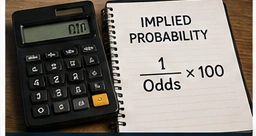
How to Calculate Implied Probability From Betting Odds
What You Need To Know
Implied probability converts decimal betting odds into the percentage chance represented by the price. It is a useful calculation because it gives bettors a common language for comparing odds with their own assessment. If you have searched for implied probability betting, you are probably looking for a practical explanation that you can actually use. That is what this guide is designed to provide. It focuses on the reasoning behind a selection rather than pretending that any football bet can be certain.
How The Market Works
For decimal odds, the basic formula is 1 divided by the decimal odds, multiplied by 100. At odds of 2.00, the implied probability is 50 percent. At 4.00, it is 25 percent. The calculation is simple, but real bookmaker markets include a margin, so the displayed probabilities across all outcomes can add up to more than 100 percent.
A Practical Example
If you estimate a team has a 60 percent chance of winning and the available odds are 2.00, the market price implies 50 percent before considering the bookmaker's margin. That difference may indicate potential value, provided your 60 percent assessment is well supported.
What To Watch Before Betting
Team news should be checked as close to kickoff as practical. A missing striker, goalkeeper or central defender can change the balance of a market. Fixture congestion can matter as well, especially when a club is moving between league matches and cup or continental competition. These details are more useful when they are connected to a clear betting reason rather than mentioned just to make an article sound detailed.
Why The Odds Still Matter
Price matters throughout the process. Two people can agree that a team is more likely to win and still disagree about whether it is a good bet because they may be looking at different odds. That distinction between prediction and price is one of the most important ideas for anyone trying to become more disciplined.
Common Mistakes To Avoid
Do not confuse implied probability with the true probability. Odds are market prices, not objective statements of fact. Also remember that a small error in your own probability estimate can remove the apparent edge.
Use A Betting Record
A simple record can improve your decision making. Note the date, market, selection, odds, stake and reason for each bet. After a meaningful number of bets, review the results by market and by type of reasoning. You may find that some ideas look attractive in theory but perform poorly in practice. That is useful information, because it tells you where to improve.
Related Guides On Todaybankertips
If you are building a broader approach, it is useful to read How to Read Football Betting Odds, Value Betting in Football and How to Compare Betting Odds. These guides cover related parts of the process and can help you connect match analysis with odds, staking and market selection.
Final Thoughts
There is no need to force a bet on every match. Sometimes the best decision is to leave a game alone because the information is unclear or the price does not justify the risk. A good betting routine includes the ability to wait. The aim should be a repeatable process that keeps financial risk under control, not the search for a guaranteed winner.
Frequently Asked Questions
Is implied probability betting guaranteed to produce winning bets?
No. Football betting involves uncertainty. The purpose of analysis is to improve the quality of a decision, not to remove risk.
What information should I check before placing a bet?
Start with the market, current team form, home or away performance, goals and chance creation, likely lineups, injuries, motivation and the available odds. Not every factor matters equally for every market.
Should I bet every time the statistics look positive?
No. Statistics are evidence, not instructions. If the price is poor, the information is conflicting or the risk is outside your staking plan, passing on the bet can be the better decision.
Good football analysis also requires patience. Do not confuse activity with progress. Spending an hour looking at a match does not mean you must place a bet. The strongest habit is to decide what evidence would make you interested in a market, check that evidence, compare the price and then either act or move on. Over time, that process produces a much clearer record of what you actually understand.







💬 Comments (0)
No comments yet. Be the first!
Leave a Comment