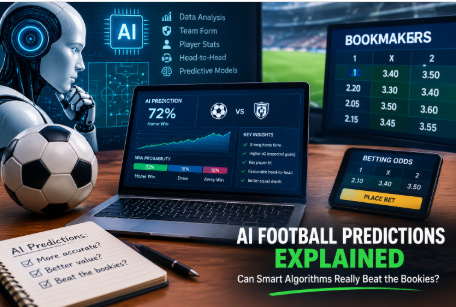
AI Football Predictions Explained: Can Smart Algorithms Really Beat the Bookies?
AI football predictions have changed how many bettors approach football betting. Instead of relying purely on instinct, supporters can now use data models that process results, player performance, injuries, tactical trends and bookmaker odds to estimate the likelihood of different outcomes.
These systems do not promise certainty. Football remains unpredictable, but a well-built model can highlight value, expose biased thinking and give bettors a more structured way to assess matches before placing a wager.
How AI Football Prediction Models Work
Modern AI football predictions rely on large datasets and machine-learning techniques. Rather than simply looking at recent results, credible models analyse deeper performance indicators such as expected goals (xG), shot quality, possession patterns, home and away form, squad rotation, injuries and historical head-to-head records.
Expected goals is particularly important because it measures the quality of chances created and conceded. A team may win 1-0 while creating very little or lose while performing well; xG helps models identify whether results reflect genuine performance or short-term luck.
Advanced systems may combine statistical approaches such as Elo ratings and Poisson-based modelling with machine-learning methods. They then compare their own probability estimates with live bookmaker odds to identify potential value bets.
The key point is that an AI model does not “know” the final score. Instead, it might estimate that a home side has a 60% chance of winning, a 25% chance of drawing and a 15% chance of losing. The bettor still has to decide whether those probabilities offer value against the available odds.
Champions League and World Cup 2026
Different competitions require different modelling approaches. In the Champions League, squad rotation, travel, knockout pressure and the quality gap between elite clubs all influence outcomes. A team may prioritise a domestic fixture one week and rest key players in Europe the next, which can make raw form data misleading.
The World Cup 2026 presents an even greater challenge because of its expanded format. The tournament will feature 48 teams, 12 groups of four and 104 matches, with the top two teams from each group plus the eight best third-placed sides advancing to a new Round of 32.
That structure creates more fixtures, more travel and less recovery time between matches. Models must therefore account for squad depth, fatigue, tournament experience and knockout-stage pressure, rather than treating every international match as if it carries the same conditions.
Current betting markets place Spain among the leading favourites for the World Cup, with France, England, Brazil, Argentina and Portugal also viewed as strong contenders.
Why “Guaranteed” Football Picks Are a Myth
Any website claiming 100% guaranteed football predictions should be treated with caution. No algorithm can accurately predict an early red card, a controversial VAR decision, a late injury, an own goal or an exceptional goalkeeping performance.
Football is a low-scoring sport, which makes single events highly influential. Even the strongest AI models can only estimate probabilities; they cannot remove variance or guarantee profit.
A responsible approach is to treat predictions as one part of the decision-making process. Compare the model’s probability with the odds, check team news, consider motivation and competition context, and avoid chasing losses after an unexpected result.
Smart Habits for Using Football Data
· Use probabilities as guidance: Treat AI outputs as an extra research layer, not an instruction to bet automatically.
· Check late team news: Confirm line-ups, injuries, suspensions and managerial changes before kick-off, as these can materially change a match.
· Understand tournament context: Group-stage matches, knockout ties and dead-rubber fixtures often produce different motivations and risk levels.
· Compare odds with probability: A prediction only becomes useful if the available price offers better value than the model’s estimated chance.
· Manage your bankroll: Set a clear staking plan, avoid emotional bets and never risk money you cannot afford to lose.
· Track results over time: Judge a prediction service on long-term performance and transparency, not one lucky weekend.
Can AI Beat the Bookies?
AI can outperform the average fan because it removes emotional bias, processes far more data and calculates probabilities consistently. However, bookmakers also use sophisticated models, sharp pricing and margins built into their odds.
The realistic goal is not to “beat the bookies” on every match. It is to identify occasional pricing mistakes, improve decision-making and maintain discipline over a large sample of bets.
Data is most powerful when combined with football knowledge. A model may flag a strong home favourite, but a bettor who notices fixture congestion, a key absence or a change in motivation can make a more informed final decision.






💬 Comments (0)
No comments yet. Be the first!
Leave a Comment